Now Available on Amazon  ·  409 pages  ·  30 chapters  ·  First Edition 2026
Now on Amazon. First Edition 2026.

The blueprint for turning the 'disorder' they gave you into the superpower you were born with.

409 pages by Len May. For the ambitious ADHD mind ready to read the wiring instead of fight it. The four markers underneath: DRD2, COMT, BDNF, FAAH.

Buy on Amazon 409 pages  ·  30 chapters  ·  By Len May
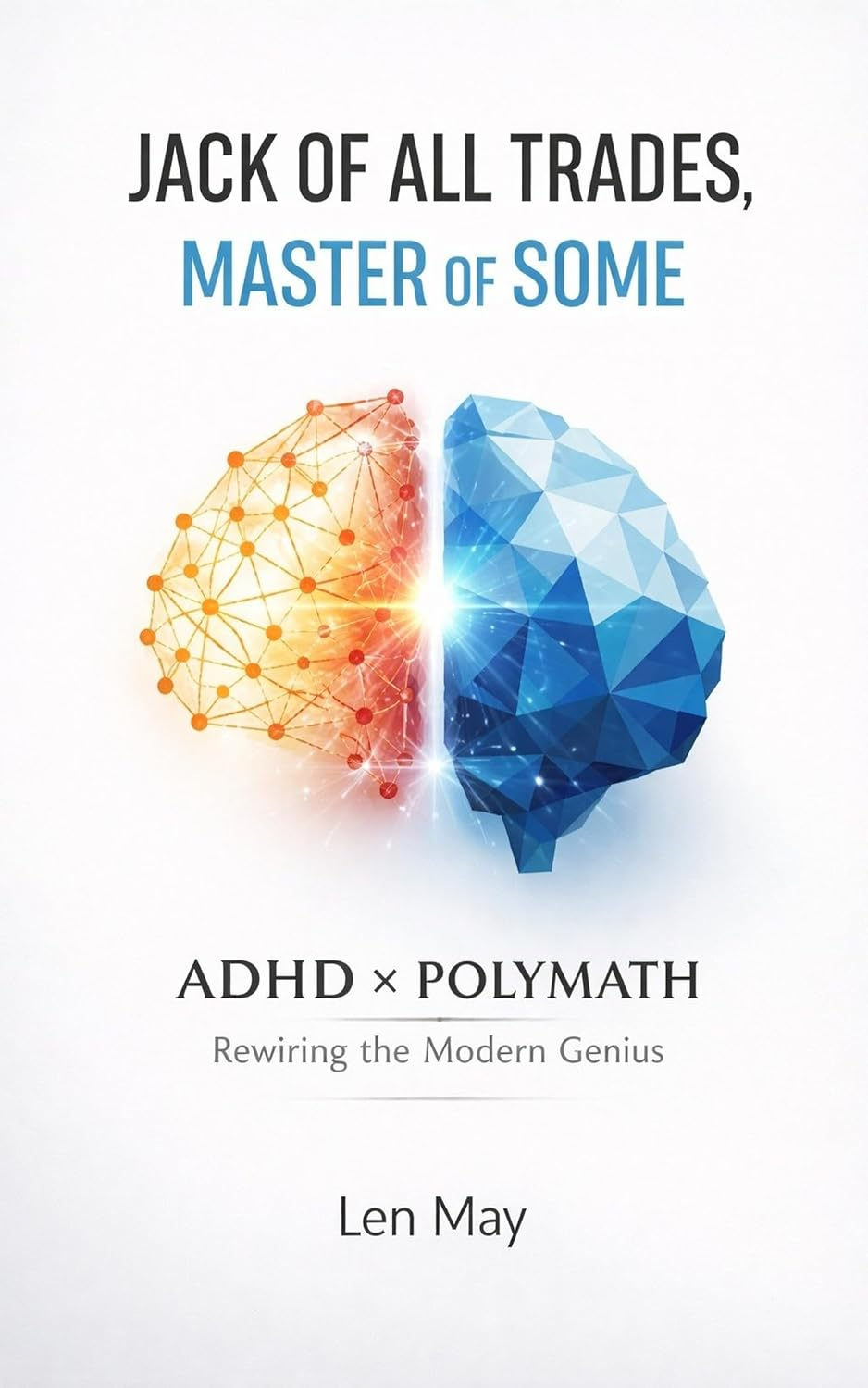
Jack of All Trades, Master of Some by Len May. ADHD book cover.
409 Pages
30 Chapters
20+ Years in Genetics
20,000+ Coaching Hours
As Seen On Bloomberg Rolling Stone Forbes LA Weekly Cheddar The Human Upgrade with Dave Asprey

Six frameworks. None of them borrowed from the productivity industry.

Every chapter names what you take with you. The science underneath. The practice on top. Read it once and the framework lives in your nervous system.

01
The four genetic markers that decide how your wiring actually performs

DRD2, COMT, BDNF, FAAH. Why some environments fuel you and others flatten you, in language you can apply the same day.

02
The five-layer Human Operating System

Hardware, firmware, software, apps, interface. A model you can use to redesign any layer of your life that is running someone else's code.

03
The Identity Algorithm

The six-step framework for rewriting the version of you that has been running since 14. Identity as code, not destiny.

04
Nine daily practices that hold what you build

Reset. Rhythm ritual. Micro boundaries. Curiosity compass. Micro bravery. And four more, detailed in Chapter 17. The architecture of staying in the body you actually have.

05
The Legacy Frequency framework

Why coherent leaders are remembered before they are gone. How the people around you absorb your nervous system before they ever hear your strategy.

06
The Polymath Path

How ambitious ADHD minds synthesize across domains as a function of how the wiring is built. Why specialization without synthesis is the slow road to burnout.

ADHD is not a deficit of attention. It is a different architecture of attention.

The book treats the mind the way an engineer treats a system. Three pillars carry the framework. Each one has a chapter or set of chapters where the science meets the lived experience.

Pillar 01

Genetics. The signal you were born with.

DRD2, COMT, BDNF, FAAH. The markers that decide how your brain processes novelty, metabolizes stress, builds new connections, and holds emotional state. Not destiny. Disposition. The book names them in plain language and shows you what each one means for how your day actually feels.

Read Chapters 6 through 10.

Pillar 02

The endocannabinoid system. The bridge between body and meaning.

The system inside you that coordinates mood, memory, stress recovery, and the felt sense of being alive. Anandamide. CB1. CB2. The book treats the ECS as the bridge it actually is, with one of the most honest chapters anyone has written on cannabis as a tool for honesty, not escape.

Read Chapter 8 and Chapter 16.

Pillar 03

The nervous system. The ceiling on everything.

Vagal tone. Cortisol rhythm. Capacity. The book makes the case that the life you want is waiting on a nervous system that can hold it, not on a better strategy. Courage is a capacity. Visibility is a capacity. Leadership is a capacity. All of it trainable.

Read Chapters 14 and 24 through 27.

Hear from the people who have lived it.

1 of 6

20+ years in genetics 20,000+ hours coaching Featured on Dave Asprey's The Human Upgrade Founder, EndoDNA Host, Everything Is Personal
LM
Len May
Geneticist  ·  Author  ·  Founder, EndoDNA

Big Four consulting, music, commercial real estate, and now genetics. Four careers that look unrelated until you understand the wiring underneath. Len has spent 20 years inside personalized genetics and 20,000 hours coaching people through what their markers actually mean for their day. He founded EndoDNA, a patented precision health platform with research partnerships at Harvard Medical School and Wayne State University. He hosts the Everything Is Personal podcast. He was diagnosed ADHD at 14 and given the brain is broken speech. He spent the next three decades proving the opposite.

He wrote this book for the kid in Philadelphia recording mixtapes under a blanket, and for everyone who has been told they are too much.

Questions

Is this another productivity book?
+
No. There are 10,000 of those books. You have probably read five of them. This book starts with biology, not behavior. It will not give you a morning routine. It will not tell you to eat frogs. It will give you a framework for understanding why every productivity system you tried lasted two weeks. The book then offers a different premise: design over discipline. Start in the Preface and Chapter 2.
Do I need an ADHD diagnosis to benefit?
+
No. The book is written for the late diagnosed, the suspecting, and the genuinely curious. Many readers find themselves in the early chapters before they ever consider whether the clinical label fits. The biology described in Chapters 6 through 10 applies whether or not you have a paper diagnosis. The framework works for any mind that has been called too much.
What if I have read every ADHD book already?
+
Most ADHD books center management. This one centers design. Most center behavior. This one centers biology and identity. You will recognize some of the territory and find a sharper map. Readers who have read Hallowell, Barkley, Brown, and Solden say this is the book that finally connects the science to the lived experience without flattening either one.
Is this just a memoir, or is there a real framework?
+
Both. The story is there because the science needs context to land. The science is there because the story needs grounding. The framework appears across the book and is named explicitly in Chapter 19 as the Human Operating System and in Chapter 22 as the Identity Algorithm. Nine daily practices live in Chapter 17. The framework is usable on its own and richer with the story.
Does this require buying anything beyond the book?
+
No. The book stands alone. There is no upsell, no required workshop, no community subscription. Some readers later choose to take a DNA test or work with Len directly through EndoDNA. The book is built so you can apply the framework without spending another dollar.
Will this help me if I am a partner or parent of someone with ADHD?
+
Yes. Many readers buy the book to understand someone they love and find themselves changed in the process. The chapters on the chemistry of curiosity, nervous system leadership, and the legacy frequency are written in a way that lets a non ADHD reader feel the architecture without having to live it.
How long does the book take to read?
+
409 pages, 30 chapters. Most readers move through it in two to three weeks. The book is designed to be read out of order. Many readers open to whichever chapter title catches them, take notes, and return. There are no prerequisite chapters. Curiosity is the only requirement.
What if I am skeptical about the cannabis chapters?
+
Good. The book is too. The chapters that touch cannabis are honest about the line between tool and escape and offer one of the most measured treatments of the endocannabinoid system written for a general audience. You can read the book without using cannabis, and nothing in the framework depends on it. Chapter 13 and Chapter 16 are the relevant ones.

If you have ever been told you are too much, this book was written for you.

409 pages. 30 chapters. The science, the story, and the framework, all in the same margin.

Jack of All Trades, Master of Some
ADHD x Polymath. Rewiring the Modern Genius. By Len May. First edition, 2026. Available now on Amazon in paperback and Kindle.
Buy the Book on Amazon

Ships from Amazon  ·  Kindle available  ·  Free preview on the listing

Buy the Book on Amazon